
Thoughts on AMD's 2026.1 Vivado Licensing Changes
Some thoughts on the new Vivado 2026.1 licensing model and how it may affect FPGA development workflows, build servers, long-term toolchains, and smaller engineering teams.
May 20, 2026 · 4 min read
Disclaimer: Before getting into this, as of the writing of this article (May 19th, 2026), AMD has not yet fully clarified some details of the new licensing structure. Some of the concerns below are based on the currently published tiers and may change as AMD provides additional information.
I'm sure by now you've heard of the licensing changes by AMD/Xilinx for Vivado 2026.1. It caused a pretty immediate reaction across parts of the FPGA world. I'd like to break down some aspects of these changes that are important to us at TE Labs.
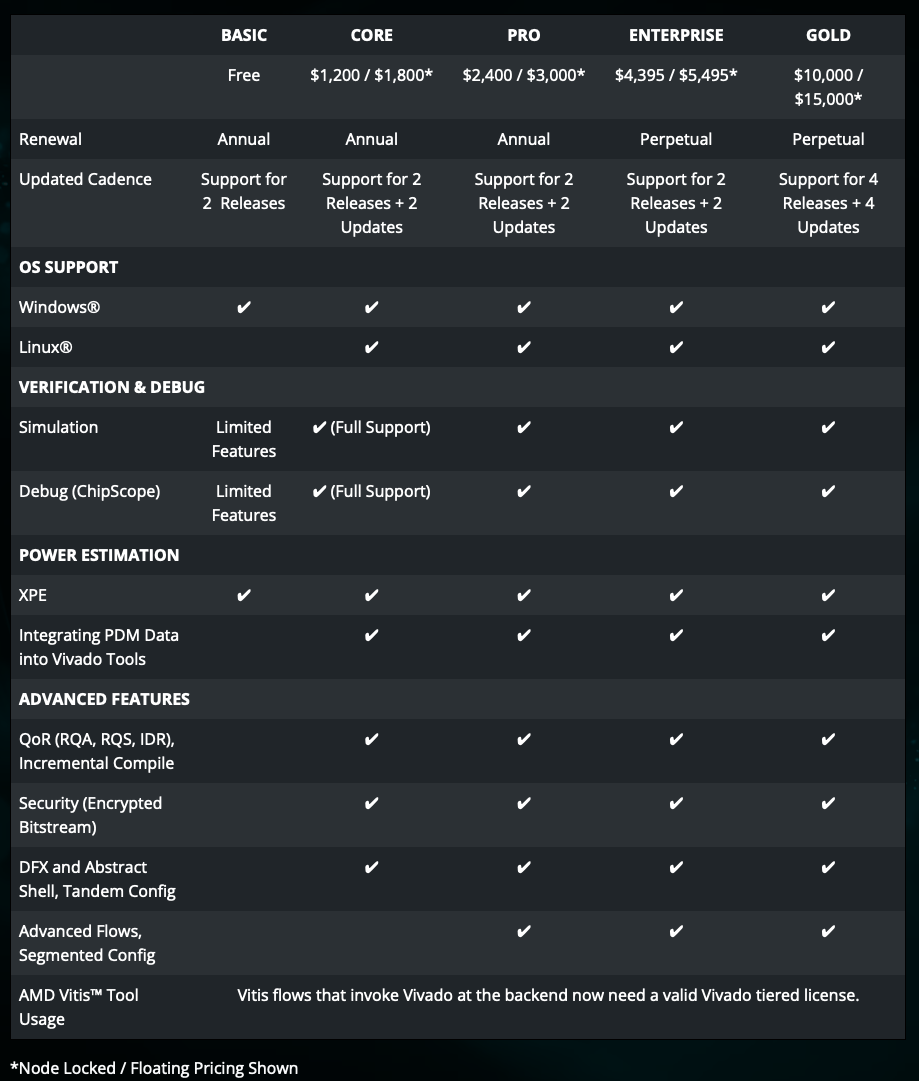
Transition from Edition-based to Tiered/SaaS-style Licenses
Vivado's previous licensing was generally straightforward:
- WebPACK/Standard
- Enterprise
- Device-limited
- IP-Limited
Vivado 2026.1 seems to move towards subscription-style tiering. The new structure introduces tier-based limitations on functionality, renewal terms, flows, and OS support. The tiers outlined by AMD are:
- "BASIC" Tier (free)
- "CORE" Tier
- "PRO" Tier
- "ENTERPRISE" Tier
- "GOLD" Tier
This is described by AMD as "more flexible" and "pay for what you need"... That sounds about normal practice in the software industry these days. But here's the concern: FPGA workflows do not follow typical software workflows.
Traditional FPGA Lifecycle
It's pretty typical for FPGA teams to:
- Freeze toolchains for years
- Intentionally avoid upgrades
- Preserve deterministic timing closure
- Avoid IP regressions
- Maintain baselines
So when AMD/Xilinx introduces:
- SaaS-style subscription assumptions
- Rolling updates
- Potentially volatile or continuously changing infrastructure
This causes a clash with FPGA design flows. The software industry's "just use the latest" way doesn't play well with FPGA design.
The Linux Support Wildcard
AMD threw a pretty major curveball here by not including Linux support in the BASIC/free tier.
Now, the exact meaning of "Linux support" still needs clarification from AMD. If this only means official support channels, that's one thing. But if the BASIC tier genuinely cannot run Vivado on Linux, then this becomes a huge issue for small and medium-sized FPGA teams.
While Windows-based Vivado environments still exist, Linux has historically been the preferred environment for serious FPGA development. Most mature FPGA infrastructures rely heavily on Linux for:
- Build servers
- CI pipelines
- Scripted flows
- Remote development environments
- Containerized tooling
That's decades of accumulated workflow infrastructure that could potentially be disrupted.
This becomes especially confusing when looking at platforms like the Kria KR26 SoM, which historically did not require paid Vivado licensing. Does this now mean Linux-based workflows for these platforms require a paid tier?
At the time of writing, AMD has not fully clarified this behavior.
ILA/Chipscope/Simulation Support
ILA (or Chipscope) is an Internal Logic Analyzer that can be easily placed to probe internal signals inside an FPGA. It's a vital debug tool that's been fully included as part of the Vivado tool suite (with similar versions provided by other vendors for their FPGAs)... until Vivado 2026.1
At this point, things start getting a little ridiculous (had this AMD announcement been in April, I'd question its seriousness). But AMD claims "limited features" for both Simulation features and "Debug (Chipscope)."
What that specifically entails in detail is to be clarified by AMD (becoming a theme here).
The limited simulation support, while still frustrating in my opinion, is to be somewhat expected. More "advanced" simulation features (e.g. UVM support) have been hidden behind a license paywall by tool vendors for quite some time. So I guess it was only a matter of time until AMD caught up.
The Small Business Impact
I'll use our setup at TE Labs as an example here:
- Our build servers run entirely on Linux with mature workflows for each vendor's tools.
- A good portion of our designs are AMD/Xilinx devices that do not require a paid license (e.g. Kria KR26)
- Unless there are specific constraints that can be met by other vendor's FPGA families, our preferred platform used to be AMD (let's face it, Vivado has had MAJOR issues, but the alternatives from other vendors aren't better).
Tool and licensing friction absolutely matter in FPGA design decisions. FPGA vendor selection is influenced by far more than LUT counts and datasheet features. As designers, we spend most of our days battling the tools to achieve what we want. Workflow stability, licensing overhead, scripting support, debug tooling, and infrastructure compatibility all heavily affect real-world engineering decisions.
And (awaiting clarification) if AMD is actively working against the accessibility of smaller design firms, hobbyists, open-source contributors, and students, then we would have to re-evaluate our strategy.
Hopefully AMD provides additional clarification over the coming weeks, especially around Linux support and the exact limitations of the BASIC tier. Vivado has had its share of issues over the years, but for many FPGA teams it still remains the most practical ecosystem overall. That's exactly why these changes are getting such a strong reaction from parts of the FPGA community.